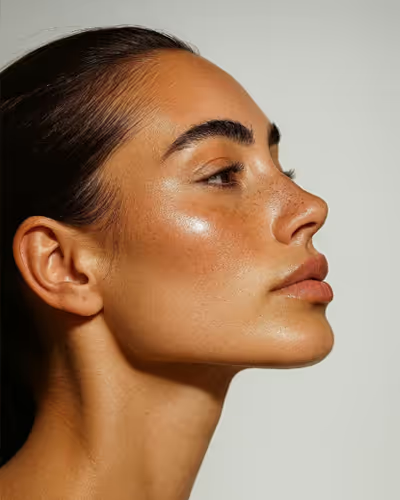
CO2 Laser (Fraxel) Frankfurt: Effects and Healing


In brief: The fractional CO2 laser, in our practice a Fraxel device, stimulates collagen production by creating tiny heat channels in a fine dot pattern. A session takes 20 to 60 minutes, the skin heals within 5 to 14 days and the final result usually shows after three months. A deep treatment is repeated after about two years at the earliest. It suits wrinkles and acne scars, but not very dark skin types.
Fine lines around the eyes and mouth, acne scars or pigment spots usually show on the face first. Fractional laser therapy targets exactly these areas and prompts the skin to renew itself. How long healing takes and how often you are treated depends mainly on whether the treatment is superficial or deep. You can find an overview of all skin rejuvenation methods at our practice on our page on laser treatment in Frankfurt.
What a CO2 laser does
A CO2 laser is a medical laser whose light is generated using carbon dioxide. The water in the skin absorbs this light particularly strongly. When it hits the skin, it vaporises tiny amounts of tissue in the uppermost layers and heats the tissue below. Specialists therefore call it an ablative laser, one that removes tissue and smooths the skin from the outside.
What does a CO2 laser do to the skin? It creates a controlled injury to which the body responds with repair. The skin forms new collagen and new elastic fibres, and removed cells are replaced by new ones. The actual smoothing therefore happens during healing, which is why the result takes time.
The laser mainly treats changes on the surface of the skin: fine lines and crinkles, acne scars and other depressed scars, sun-related pigment spots, large pores and an uneven skin texture.
Its limits lie where the problem is not in the skin itself. The laser cannot lift skin that has already clearly sagged; surgical methods are more suitable for that. For thick skin with deep wrinkles, in our experience a phenol peel reaches the deeper collagen layers more intensively. And for very dark skin types we advise against the CO2 laser because the risk of pigment changes increases.
Fractional CO2 laser: how it works
Fractional means that the laser does not remove the entire surface but works in a fine dot pattern. Untreated skin remains between the tiny treatment points. From there the small wounds close faster than after a full-surface treatment, and downtime is shorter. A fractional laser thus combines the effect of CO2 light with a shorter healing time.

How deep the fractional CO2 laser penetrates can be adjusted. This determines how the treatment works and how long the skin needs to heal.
Fraxel laser and CO2 laser: the difference
Many people search for a Fraxel laser and mean the same treatment as with a CO2 laser. The terms are not quite identical, though. Fraxel is the brand name of a range of laser devices. It includes devices that only heat the skin without removing it, and one device that works with CO2 light. CO2 laser, on the other hand, describes the technology itself.
All Fraxel devices share the fractional principle, which is why "Fraxel" has become an everyday word for fractional laser treatments. At our practice we work with the Fraxel device that uses CO2 light. It removes the uppermost layers of skin and therefore works deeper into the skin structure than a laser that only heats. In return, the skin needs a little longer to heal.
CO2 laser on the face: where it is used
What does a CO2 laser achieve on the face? That depends on what is being treated. Laser therapy on the face is most often used for the following concerns.
Smoothing facial wrinkles
Fine lines around the eyes and mouth, crow's feet and forehead lines develop when the skin loses collagen and elasticity. Thanks to collagen remodelling after the treatment, the skin usually becomes smoother and firmer. Fine lines generally respond better than deep furrows.
Treating acne scars and pigment spots
With acne scars and other depressed scars, the laser evens out the transitions to the surrounding skin so that the scars can look flatter. Sun-related pigment spots, large pores and an uneven texture can also be treated.
Laser treatment on neck, décolleté and the backs of the hands
Signs of sun and age also show on the neck, décolleté and the backs of the hands. These areas can be lasered too. Because the skin there is thinner, the settings are adjusted accordingly.

Who CO2 laser treatment is suitable for
The treatment suits women and men whose skin has lost smoothness through sun, age or acne. Skin type plays a major role. Dermatology classifies it on the Fitzpatrick scale, from type I for very fair to type VI for very dark skin. The darker the skin, the higher the risk of light or dark spots after treatment.
Fair to medium skin types, types I to III, can usually be treated well. With type IV we laser only with particular caution. For types V and VI we advise against CO2 laser treatment. It is also not suitable with acute severe acne, during or shortly after acne therapy with isotretinoin, with a tendency to raised scars, with certain skin diseases and during pregnancy and breastfeeding.
The CO2 laser treatment step by step
Skin analysis
Before every treatment we examine your skin closely and discuss what bothers you. For the skin analysis we use the VISIA system. It reveals pigment disorders, sun damage and signs of skin ageing that are hard to judge with the naked eye.
Preparing for laser treatment
In the four weeks before treatment, avoid intense sun and solarium, as tanned skin reacts more sensitively. Stop creams with retinoids or fruit acids a few days beforehand after consulting us. If you have had acne therapy with isotretinoin in recent months, be sure to tell us, as we will then postpone the laser treatment. If you have ever had cold sores, you will receive medication before the treatment to prevent a new outbreak.
Superficial or deep CO2 laser
Based on the analysis we decide together how deep to laser. In a superficial treatment the laser passes over the skin once. In a deep treatment, for example on the whole face, it penetrates further. Which option suits you depends on your wishes and on how much elasticity your skin has already lost, known medically as elastosis. The depth determines anaesthesia, healing time and how often you are treated.
Anaesthesia
For a superficial treatment we numb the skin locally, similar to the dentist, or with a numbing cream. Deep treatments, for example on the whole face, are carried out under short general anaesthesia at the Berger Klinik. You usually feel little of the treatment itself.
How long does CO2 laser treatment take?
Depending on the area, 20 to 60 minutes. The laser emits short light pulses that hit the skin in a fine grid. Afterwards we apply a care cream.

Skin care after laser treatment
Which cream is right after facial laser treatment? That depends on the healing phase. In the first two weeks the skin needs a rich wound healing and care cream. In weeks three and four you switch to a lighter care cream without acids. After four weeks, add SPF 50 during the day, and in the evening you can apply a rich overnight mask, also without acids. You also receive detailed instructions on care and sun protection from us.
You can usually rinse your face with lukewarm water in the shower from the first day, unless an operation was performed at the same time. Use a pH-neutral cleansing lotion or gel from the pharmacy only after ten days.
Laser treatment is possible in any season, even in summer. What matters then is consistent sun protection with a cap and sunglasses. We explain exactly how to protect yourself during the sunny months.
Combining CO2 laser and PRP
On request we combine the laser with a PRP treatment, which uses platelet-rich plasma from your own blood. We recommend the first treatment three days after the laser and a second after 14 days. In our experience this can support healing of the treated areas.
CO2 laser on the face: healing and downtime
What do you look like after facial laser treatment? That depends on the depth, but the course can be described well.
In the first days the skin is red, swollen and feels tight. Depending on depth, it weeps slightly and fine crusts may form, which fall off on their own. After a superficial treatment the swelling subsides within a few days, and you can usually work again after a few days.
The skin heals in the first two weeks, taking 5 to 14 days depending on depth. Make-up is usually possible again after 8 to 10 days. After a deep treatment you can usually work again after 14 days.
In the following weeks a slight pink tone usually remains, for a few weeks up to three months at most. It is easy to cover with make-up and shows that collagen formation is still under way.
Dr. Julia Berkei knows this course not only as a physician: she has had her own face treated with the laser four times over the past 20 years.
Result and durability
When can you see the result after CO2 laser treatment? Clear smoothing is often visible after 14 days, though swelling, medically called oedema, and redness are still present then. The final result usually shows after about three months, because the new collagen builds up over this period. For most people the skin then looks smoother with finer pores and a more even tone.
How often you are treated depends on the depth. Superficial treatments usually involve two to three sessions four to six weeks apart, with the skin improving gradually over a year. A deep treatment usually needs one session.
How long the result lasts also depends on the depth. After a deep treatment a refresh makes sense after about two years at the earliest; superficial treatments can be repeated much sooner. Natural skin ageing continues after treatment, and consistent sun protection helps the result last longer.
Risks and side effects of the CO2 laser
The CO2 laser removes skin, so the treatment belongs in experienced medical hands. After every treatment you can expect redness, swelling and a feeling of tightness. Depending on depth, the skin weeps in the first days and forms fine crusts. These reactions are part of healing and fade over the following days and weeks.
Temporary dark spots in the weeks after treatment, medically called post-inflammatory hyperpigmentation, are not uncommon. The risk rises with darker skin types and sun exposure during healing. The spots usually fade over a few weeks to months. Rarely, lighter areas remain permanently.
Anyone who has had cold sores can get a new outbreak after laser treatment, which is why we prevent this with medication beforehand. Bacterial infections are rare.
Another risk is scarring. We see it mainly when the treated skin is scratched during sleep. We therefore recommend cutting your fingernails very short before treatment, sleeping on a silk or cotton pillowcase and avoiding any friction on the treated area in the first week. If you notice anything during healing, contact the practice rather than waiting.
What the cost of CO2 laser treatment depends on
The cost of a facial CO2 laser treatment can only be given after the skin analysis, because several factors come together.
The most important is the area. Treating the eye area is much smaller than the whole face, and adding neck, décolleté or the backs of the hands enlarges the area further. Then there is the depth: a deep treatment is more complex and is performed under short general anaesthesia at the Berger Klinik, while a superficial one only needs local anaesthesia or a numbing cream. The number of sessions also plays a role: superficial treatments usually take two to three, deep ones usually one. If you combine the laser with PRP, these treatments are included as well.
After the skin analysis you receive a written cost plan covering all steps.
Facial laser treatment in Frankfurt
Our practice is located at Goethestraße 25 in the heart of Frankfurt, and consultations take place at our satellite location on Fressgasse. Deep laser treatments under short general anaesthesia are performed at the Berger Klinik. The practice is headed by Dr. Julia Berkei. Facial laser treatments are performed exclusively by physicians with the required qualification, from skin analysis and laser settings to aftercare.

Before every treatment we analyse your skin with the VISIA system and then decide together whether to laser superficially or deeply. On request we combine the laser with PRP. If your skin is better suited to another method, such as a phenol peel for thick skin with deep wrinkles or microneedling for milder scars, we discuss this option with you too. That way the recommendation is based on your skin.
Frequently asked questions about the CO2 laser
Which cream do I need after facial laser treatment?
In the first two weeks after CO2 laser treatment the skin needs a rich wound healing and care cream. In weeks three and four a lighter care cream without acids follows. After that, add SPF 50 during the day and a rich mask without acids in the evening.
How much does facial CO2 laser treatment cost?
The cost depends on the size of the treated area, whether the treatment is superficial or deep, how many sessions are needed and whether short general anaesthesia is required. You receive a written cost plan after the skin analysis at our practice.
How often can you be treated with the CO2 laser?
That depends on the depth. Superficial treatments are usually performed two to three times, four to six weeks apart. After a deep CO2 laser treatment, repeating it usually makes sense after about two years at the earliest.
How long does CO2 laser treatment last?
How long the result lasts depends on how deep the laser penetrated. After a deep treatment we recommend a refresh after about two years at the earliest. The skin continues to age naturally, and consistent sun protection helps the result last longer.
When can I wash my face after CO2 laser treatment?
You can usually let lukewarm water run over your face in the shower from the first day, unless another operation was performed. A pH-neutral cleansing lotion or gel from the pharmacy is added only after ten days.
When can I wear make-up again after CO2 laser treatment?
Make-up is usually possible again 8 to 10 days after CO2 laser treatment. The slight pink tone that may remain for a few weeks up to three months can then be covered easily.
Who is allowed to perform CO2 laser treatment?
In Germany, since the end of 2020, ablative laser treatments such as the CO2 laser may only be performed by licensed physicians with the appropriate qualification. Specialists in plastic and aesthetic surgery and dermatologists acquire it during their specialist training, other physicians through a recognised course. At our practice only physicians with this qualification perform laser treatments.
Carbon peel or CO2 laser: what is the difference?
In a carbon peel, a layer of carbon is applied and heated with laser light; it works mainly on the surface. The CO2 laser removes skin in fine dots and stimulates collagen formation. We do not offer carbon peels; for thick skin with deep wrinkles a phenol peel is an alternative.
Conclusion
The fractional CO2 laser smooths the skin by removing it in a fine dot pattern, which stimulates the build-up of new collagen. Whether the treatment is superficial or deep determines anaesthesia, healing time and the number of sessions. Expect 5 to 14 days of healing and about three months until the final result. The treatment suits fair to medium skin types well; for very dark skin we advise against it. If you would like to know whether the CO2 laser is right for your skin, book a consultation at our practice in Frankfurt.
Sources
German Dermatological Society, German Society of Plastic, Reconstructive and Aesthetic Surgeons et al.: S2k guideline Laser Therapy of the Skin, AWMF register no. 013-095, 11 January 2022.
Federal Office for Radiation Protection: Ordinance on Protection against the Harmful Effects of Non-Ionising Radiation in Applications on Humans (NiSV).
Medically reviewed by Dr. Julia Berkei, specialist in plastic and aesthetic surgery. Last updated: October 2026.
Livia Berkei
Resident Physician in Plastic and Aesthetic Surgery
Livia Berkei is a licensed physician in specialist training in plastic and aesthetic surgery at the Dr. Berkei practice in Frankfurt. In the B Journal she explains procedures and aesthetic treatments so that you can go into your consultation well prepared.