



Masseter Botox for Teeth Grinding: Effect, Procedure and Duration



In brief: Masseter Botox eases night time teeth grinding by relaxing the overactive chewing muscle. The treatment itself takes about 15 minutes. The relief becomes noticeable after 2 to 3 days, reaches its full effect after about 2 weeks and usually lasts 4 to 6 months. It is used for bruxism as well as for jaw pain and tension headaches.
Most patients only notice that they grind their teeth when the dentist points at the worn chewing surfaces or when the jaw feels tight in the morning. The muscle work that happens at night is considerable, and it runs unconsciously. A bite splint protects the teeth from the consequences, but it changes nothing about the overactive muscle itself. Treatment with botulinum toxin starts at that muscle.
What is masseter Botox?
In masseter Botox, botulinum toxin A is injected into the masseter, the large chewing muscle at the side of your lower jaw. The active substance blocks the transmission of the signal at the point where the nerve controls the muscle. The muscle therefore works with less force, but it is not switched off: chewing, speaking and yawning continue to work as usual.
The treatment is not a surgical procedure. It takes place on an outpatient basis in the practice, without anaesthesia and without downtime. After about 30 minutes including examination and consultation you can leave again.
Botulinum toxin is the same active substance as in wrinkle treatment, here with a different goal. There it is about the fine muscles of facial expression under the skin, for example with Baby Botox. With the masseter it is about a strong chewing muscle with considerably more substance. The quantity and the injection depth differ accordingly. You can find more about the individual applications on our page on Botox in Frankfurt.
Botox in the chewing muscle: where the masseter sits
The masseter runs from the cheekbone to the angle of the lower jaw and pulls the lower jaw upwards. To feel it, place two fingers on your jaw angle and clench your teeth. The muscle that tightens under your fingers is the masseter.
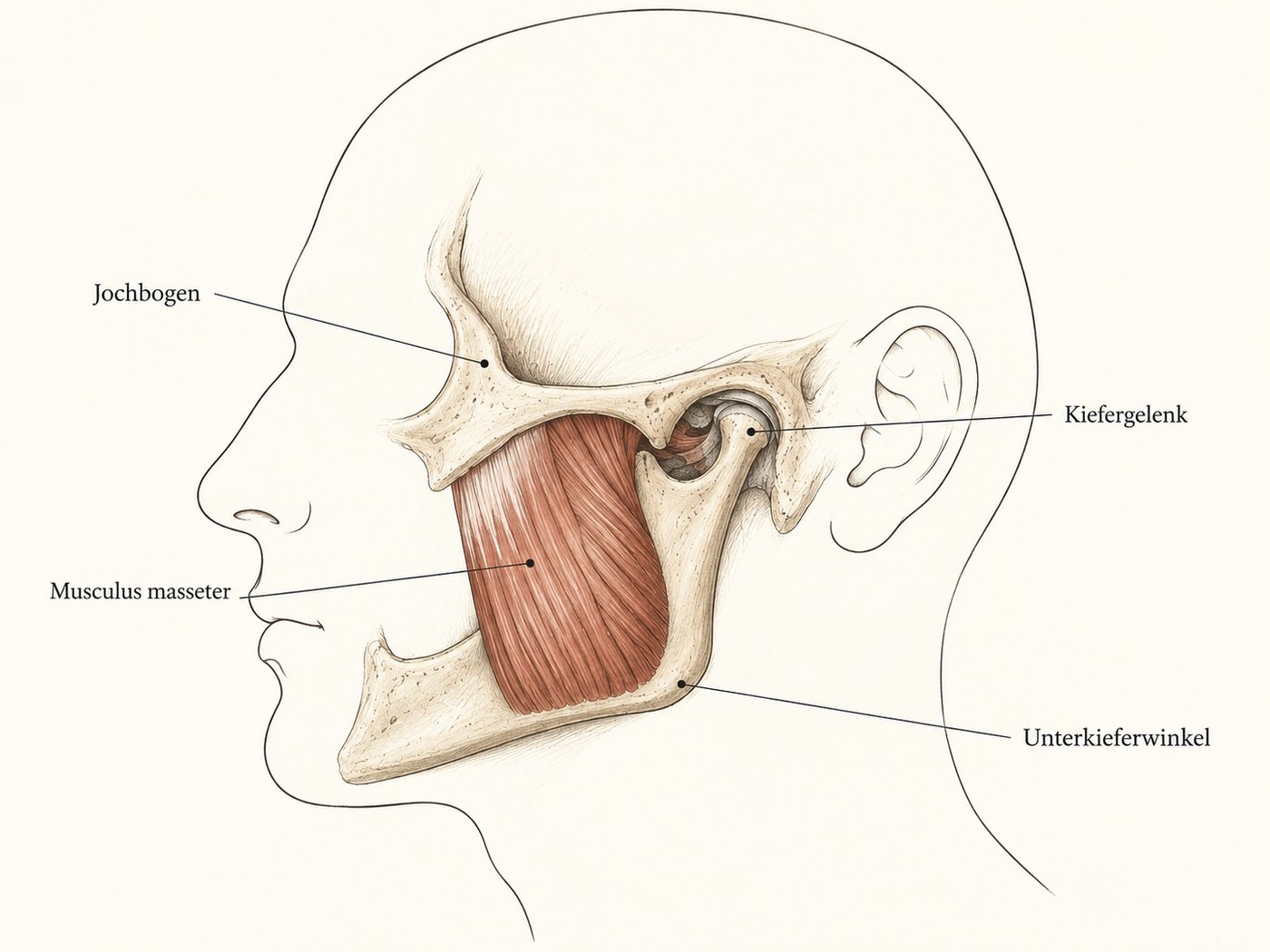
Like every muscle it responds to permanent strain by growing. Anyone who grinds or clenches at night over years therefore trains it involuntarily. This becomes visible in a more angular looking jaw area and noticeable as pressure or pain in the jaw joint and in the temple.
This is where Botox in the chewing muscle comes in. When Botox is injected into the jaw, the resting tension of the masseter drops without its function being removed.
Botox for teeth grinding
When you grind, you press your teeth together with a force that is hardly reached when biting down consciously. This happens during sleep, over hours, without you being able to control it. The chewing muscle works against a resistance that does not give way, namely against your own teeth.
Botox for teeth grinding does not act on the teeth but on the muscle that produces the force. After the treatment the masseter can no longer contract at full strength. It stays able to work but loses the peak force that puts the greatest strain on tooth enamel and the jaw joint.
A bite splint, by contrast, sits between the rows of teeth and absorbs the pressure, while Botox for grinding lowers the force of the muscle. Because the masseter works with reduced force after the treatment, the splint is usually no longer necessary afterwards. If you feel more comfortable with it you can still keep wearing it, Botox for teeth grinding and a splint do not rule each other out.
The relief usually becomes noticeable after 2 to 3 days, mostly in the morning first, because the jaw feels softer on waking. The full effect sets in after about 2 weeks.
Bruxism and Botox
Bruxism is the technical term for what is colloquially called teeth grinding. It means repeated activity of the chewing muscles: grinding, clenching or tensing the lower jaw without tooth contact. A distinction is made between sleep bruxism, which happens at night, and awake bruxism, which occurs during the day and is often connected with tension or strong concentration.
The triggers are considered to be above all stress and sleep disorders, alongside certain medications and neurological factors. According to the current S3 guideline on bruxism of the German Society for Functional Diagnostics and Therapy (in German), primary bruxism is currently not regarded as curable at its cause. The symptoms can usually be eased with botulinum toxin.
What can be done about bruxism? The path usually begins at the dentist: protecting the teeth with a splint, checking the bite, and where stress is the trigger also relaxation methods or physiotherapy.
Botox for bruxism is therefore not a treatment of the cause, it reduces the force of the muscle. According to the study situation, Botox for bruxism is mainly an option when symptoms already exist: persistent pain in the jaw, visible wear on the teeth, a clearly thickened chewing muscle, or when a splint and relaxation methods are not enough.
The treatment step by step: Botox into the masseter
Examination and consultation
First the chewing muscle is palpated, once relaxed and once while you bite down firmly. From that it follows how strongly the masseter is developed, whether both sides work equally and how many units make sense. 20 to 25 units per side are common, the exact quantity is determined individually. In addition there is the conversation about effect, course and possible side effects.
The injection
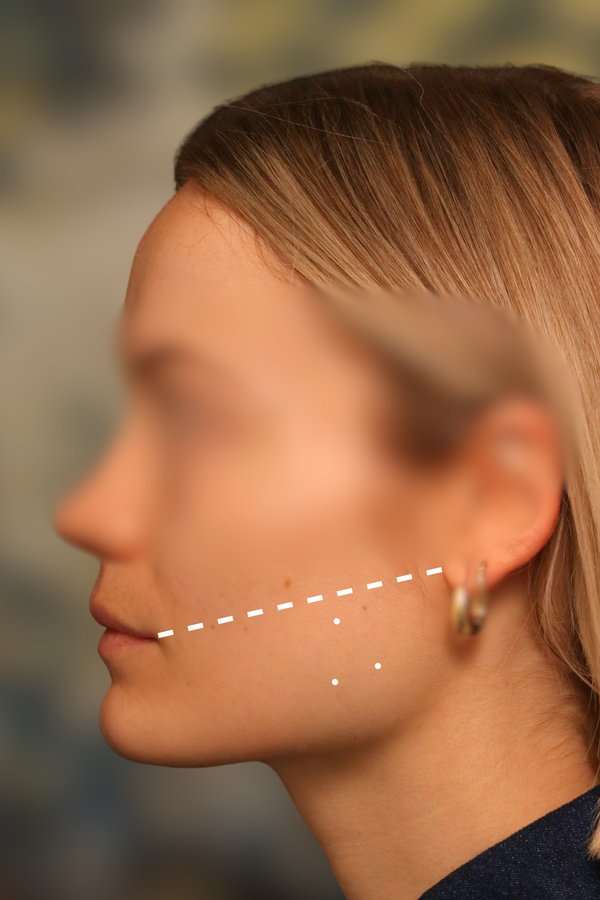
The skin is disinfected. The injection is given while you clench your teeth, because the belly of the muscle can be delineated reliably under tension. Botox into the masseter is placed deep, directly into the muscle belly and not into the tissue above it. The quantity is distributed over three points per side so that the relaxation is even. Fine needles are used, an anaesthetic is not necessary.
After the treatment
The treatment itself takes about 15 minutes, around 30 minutes including examination and consultation. You can go back to work straight afterwards. Swelling at the injection sites usually subsides on the same day. For the first 24 hours the rule is: do not lie on the treated side, do not massage the area, no sport and no sauna.
Who masseter Botox is suitable for
Masseter Botox is mainly an option for adult patients who:
- regularly grind or clench at night
- suffer from tension headaches or jaw pain
- already wear a bite splint and still have symptoms
- are looking for a treatment without surgery and without permanent medication
The treatment is not suitable during pregnancy and breastfeeding or with certain neuromuscular diseases. It is also not carried out where an intolerance to components of the preparation is known. If the grinding goes back to an untreated malocclusion, that needs to be clarified first.
Whether the treatment makes sense for you is something we clarify in the first consultation.
Botox facial slimming: the aesthetic side effect
When the chewing muscle works less, its volume decreases, in the same way that an upper arm loses circumference when it is no longer trained. The jaw area therefore usually looks narrower and the lower third of the face softer. This effect is called facial slimming.
As a rule the effect shows after the first treatment already. It can take up to 4 weeks, however, until the muscle is visibly slimmer. How clearly the change turns out depends on how pronounced the muscle was beforehand. With a naturally slim masseter hardly any change is to be expected.
Botox facial slimming can also be treated as a goal of its own, without bruxism being present. Technically there is hardly any difference, the dose and the choice of points can vary. If your concern is the contour of the jawline as a whole, jawline injections may be the more suitable route, because they build volume instead of reducing it. What makes sense in your case is something we clarify in the consultation.
When masseter Botox works and how long it lasts
- Onset: after 2 to 3 days
- Full effect: after about 2 weeks
- Duration: usually 4 to 6 months
- Refresh: every 4 to 6 months
The effect does not end abruptly, it wears off gradually. The muscle rebuilds the signal transmission step by step, the force increases, and at some point the symptoms return. That is the moment for a refresh.
How long it lasts in the individual case depends on the starting strength of the muscle, on the quantity chosen and on how heavily you grind.
Masseter Botox experiences: what the literature describes
Anyone searching for masseter Botox experiences usually wants to know whether the treatment helps and what comes afterwards. Individual accounts are of little help there, because every chewing muscle is developed differently. What the specialist literature describes is more meaningful.
What is described above all is a measurable decrease in maximum bite force and with it a lower strain on hard tooth substance and on the jaw joint. Because the masseter is functionally connected with the temple and neck muscles, a decrease in tension headaches is also observed in some of those treated. Whether the grinding events themselves become less frequent is not answered consistently in the specialist literature. The effect does not occur in everyone and it does not replace clarifying the cause.
The muscle is not paralysed in the process. Chewing, speaking and laughing stay unchanged. In the first weeks, chewing something very firm can feel unfamiliar, because the maximum bite force decreases.
Masseter Botox: risks and side effects
Masseter Botox is regarded as low in risk when applied professionally. Side effects are usually temporary and subside on their own.
More frequent and harmless:
- redness, tenderness or a small bruise at the injection sites
- a feeling of tension in the jaw in the first days
- headache shortly after the treatment
Less frequent:
- an asymmetrical result if the two sides respond differently to the dose
- an unfamiliar feeling when chewing hard food
- a changed smile if the active substance also reaches adjacent muscles
If one side responds more strongly than the other, you come to us for a check and we balance the difference with a small follow up injection.
Disadvantages of masseter Botox
Masseter Botox has disadvantages that you should know before you decide. The effect is limited in time, it is not a permanent solution, and the cause of the grinding remains. With regular use over several years the muscle is also strained less and less and recedes. That can be desirable aesthetically. If you stop the treatment after years, however, it takes considerably longer for the masseter to regain its original strength and shape.
Masseter Botox cost: what it depends on
There is no flat price, because the chewing muscle is developed to a different degree in every person. How much botulinum toxin is needed is only decided once the muscle has been palpated.
These points determine the effort involved:
- how strongly the masseter is developed and how many units follow from that
- whether one or both sides are treated
- whether it is a first treatment or a refresh
- whether a follow up check is planned
What the treatment means in your case can only be said properly after the examination. In the first consultation the chewing muscle is examined, you receive an assessment and a concrete cost estimate before you decide. You can book a consultation appointment in Frankfurt directly online.
Masseter Botox in Frankfurt
Our practice is located on the Fressgass in the heart of Frankfurt, a few minutes from Hauptwache and Opernplatz.
Masseter Botox is carried out by our doctors. Before the first treatment the chewing muscle is palpated on both sides, in a relaxed state and under tension. Only from that does the quantity follow that makes sense in the individual case.
The targeted treatment of the jaw muscle with Botox is not a surgical procedure. It takes place on an outpatient basis, without anaesthesia. If you are unsure whether it is an option for you, we clarify that in the first consultation, including with the outcome that we advise you against it.
Frequently asked questions about masseter Botox
What is masseter Botox?
Masseter Botox is the injection of botulinum toxin A into the large chewing muscle. It lowers the activity of that muscle and is used for night time teeth grinding. The muscle stays functional but loses force. The treatment takes about 15 minutes.
What is bruxism?
Bruxism is the technical term for repeated activity of the chewing muscles, meaning grinding, clenching or tensing the lower jaw. A distinction is made between sleep bruxism and awake bruxism. Common triggers are stress, sleep disorders, certain medications and neurological factors.
When does masseter Botox work?
You feel the first changes after 2 to 3 days, the chewing muscle becomes softer. It takes about 2 weeks for the full effect to show. Before that it cannot be judged how strongly the chosen dose works.
How long does masseter Botox last?
Usually 4 to 6 months. After that the muscle activity increases again and the treatment can be refreshed. How long it lasts for you depends on how strong the chewing muscle is and how heavily you grind.
What does masseter Botox cost?
There is no flat price. The cost depends on the quantity needed, on whether one or both sides are treated, and on whether it is a first treatment. You receive the concrete amount in the first consultation after the examination.
How many units of Botox does the masseter need?
20 to 25 units per side are common. The exact quantity is only determined after the muscle has been palpated, because the masseter is developed to a different degree in every person. We discuss the quantity with you before the treatment.
How often does the treatment have to be repeated?
Usually every 4 to 6 months, as soon as the effect wears off. The exact interval depends on how strong the chewing muscle is and how heavily you grind. There is no fixed rhythm, it is decided on the basis of the examination.
Can I eat and speak normally after the treatment?
Yes. The basic function of the chewing muscle is retained, there are no restrictions in everyday life. Speaking, laughing and yawning continue to work as usual. In the first weeks, chewing something very firm can feel unfamiliar, because the maximum bite force decreases.
Do you have a question that is not answered here? Then send us a message on Instagram at @dr.berkei. You get a personal assessment of your chewing muscle in the first consultation at the practice.
Conclusion on masseter Botox
Masseter Botox is one way to relieve the overactive chewing muscle when teeth grinding leads to pain in the jaw, headaches or damage to the teeth. The effect sets in after a few days and usually lasts several months. It does not treat the cause of the grinding, and for some patients it is not suitable.
Whether it makes sense in your case can only be said after an examination of the chewing muscle. Book a consultation appointment.
Author: Livia Berkei, Resident Physician in Plastic, Aesthetic and Reconstructive Surgery
Medically reviewed by Dr. Perihan Gerger